
Shelbyville Previous Residents by Era
Different Shelbyville sources reach different periods and describe different facts. Deeds follow the land and recorded transfers. Directories and census publications may put people near an address at a particular time. Maps date physical context. Permits date a project rather than a household. The table provides a practical starting order without claiming that any series is annual, complete, or searchable in one place.
| Source | Years It Covers | Where Held | What It Shows |
|---|---|---|---|
| Register deed originals | 1808-current stated by Archives | Register of Deeds; older archive finding aids | Recorded ownership and legal-description chain; online cutoff not stated |
| WPA General Index to Deeds | 1808-1840 | TSLA and Bedford Archives leads | Early grantor and grantee index, subject to volume verification |
| Burned Deed Index | 1852-1861 | TSLA Bedford published material | Reconstruction lead after record loss, not a substitute for an original deed |
| Polk directory runs | 1999; 2004-07; 2009-15 | TSLA and library route | Alphabetical local clues; reverse sections are not confirmed |
| Federal census material | 1820, 1850, 1880 published; 1920-1950 public schedules | TSLA and library or National Archives routes | Household and residence snapshots, not annual occupancy |
| Sanborn map | 1891, five sheets found | Library of Congress | Building, street, material, and use context, not occupant names |
Start with TPAD for a modern parcel identity. Move to the Register for a book/page trail. For an older address, let the legal description, plat, and map position guide the directory or census search. Current records remain with the originating office, while Bedford County Archives preserves specified early county series and offers a research room.
Bedford County Archives is in Courthouse Suite 105, 1 Public Square, with published hours of Monday through Friday, 8:00 a.m. to 4:00 p.m.; its listed phone is 931-735-6916 and email is archives@bedfordcountytn.gov. Give staff the address, known names, date span, and record type. Ask whether the lead is an original, microfilm, transcription, clipping file, or database image, since each format has different limits and citation needs. Confirm whether the relevant series is held there or remains with the originating office.
Shelbyville Parcel Records Start with TPAD
TPAD supplies the current anchor for a Shelbyville address: owner, property address, mailing address, control map, group, parcel, subdivision, lot, class, and sale-history fields. The mailing address may be a post-office box or another city, so it should not be used as proof of where a former owner lived. Capture the situs address and parcel components before looking at an older record.
The sale history may show a date, price, book, page, instrument, and qualification. It is a pointer to the deed, not the deed image itself. A transfer can also be a quitclaim or a transaction with no stated price, so document type and legal description matter more than one sale-line label.
Shelbyville Address History Deed Chain
Use the legal chain to identify former recorded owners, then separately test whether another source supports a household connection. The official Register of Deeds page confirms the office and links a title-search service, but it does not publish a public form's fields, image fees, or web coverage start. For a missing online step, use the recorder counter, phone, title-route terms, or the archive finding aids.
- Save the current TPAD owner, situs address, control map, group, parcel, subdivision or lot, legal description, and most recent sale book/page.
- At the Register, locate that book/page and write down the grantor, grantee, deed type, recording date, consideration if visible, legal description, and prior-instrument reference.
- Find the seller as a grantee in the earlier purchase. Compare the legal description before accepting it as the same parcel.
- Repeat the backward search, preserving each book/page and any plat reference. A lot split, consolidation, or metes-and-bounds description can break a street-number-only search.
- For older instruments, ask the Register or Bedford County Archives about original deed access, Trust Deeds for 1868-1940, and the published WPA leads.
- Grantor
- The person or entity transferring an interest in a recorded instrument.
- Grantee
- The person or entity receiving that recorded interest.
- Chain of title
- The sequence of recorded transfers for the same parcel, checked by legal description and references.
- Legal description
- The land language in a deed or plat, such as a lot and subdivision or metes and bounds. It remains stronger than an old street number.
The Bedford County Register of Deeds is the recorded-instrument custodian.
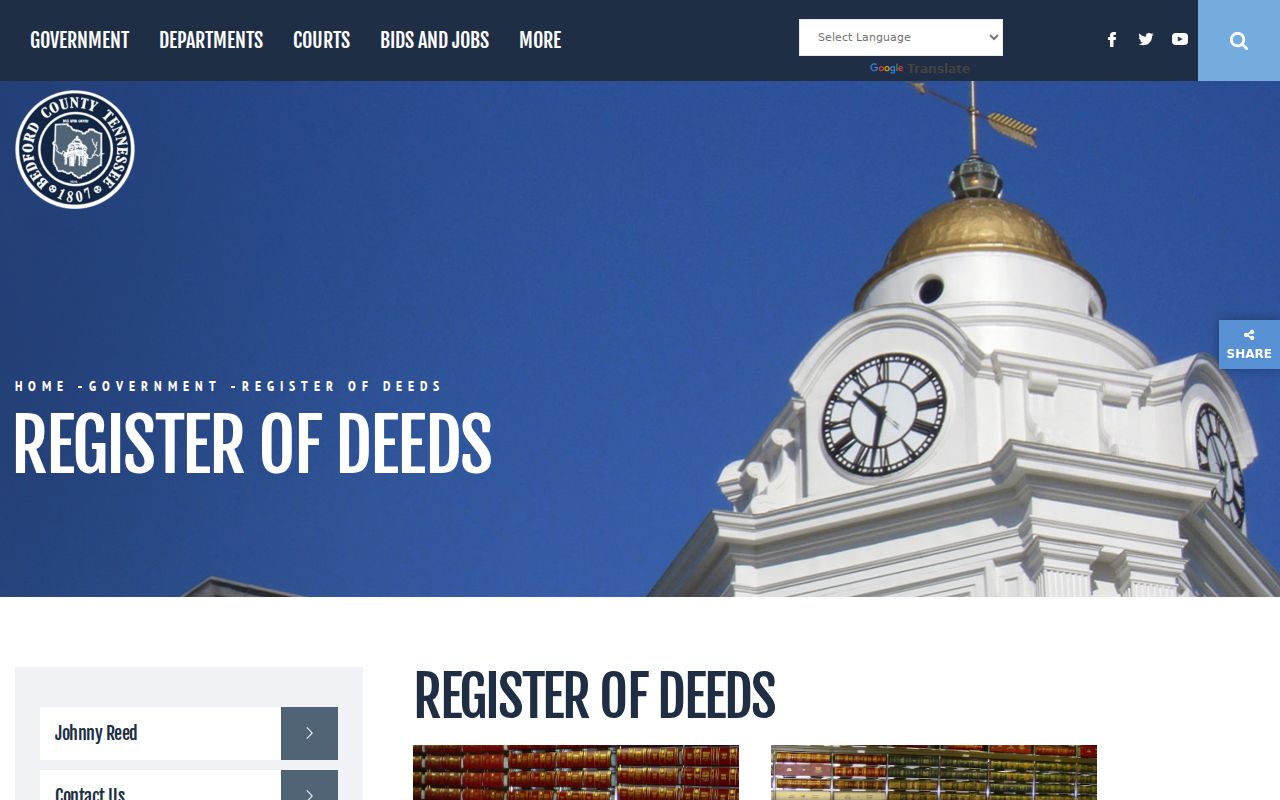
The recorder route is essential when the parcel card points to an earlier transfer. The public page should be treated as a custodian route, not as proof that a complete free deed chain is available online.
Shelbyville Records Through Loss
Bedford County's record memory has gaps for concrete reasons. County Archives names an 1830 tornado, an accidental Civil War fire in 1863, and a courthouse riot-mob fire in 1934. The WPA General Index to Deeds for 1808-1840 and the Burned Deed Index for 1852-1861 are therefore important local reconstruction tools. A missing entry is not proof that a transfer or household never existed.
Copy the publication title and page, then look for confirmation in a later deed, plat, court minute, tax entry, newspaper notice, or estate file. Archives also describes early Chancery, Circuit, County Court, guardianship, settlement, marriage, and deed-related series. The trail may continue in a loose file, an initial, a spouse's name, or a later reconstruction.
Note: A reconstructed index is a research lead, so retain its citation and seek the surviving instrument or corroborating record.
Shelbyville Historical Directory Clues
Directory and census evidence adds the household layer that deeds cannot supply. TSLA identifies a 1999 South Central Tennessee Regional Polk directory and Coffee/Franklin/Bedford Polk runs for 2004-07 and 2009-15. It also lists a 1879-80 Shelbyville directory catalog lead and a 1895 telephone directory that includes Shelbyville among several Tennessee places. The collection records are leads, not proof of a continuous annual shelf or address-arranged section.
The Shelbyville-Bedford County Public Library links TSLA, Tennessee Virtual Archive, Census, Library of Congress, local archives, and local newspaper resources. Ask for a catalog title, year, call number, reverse-directory status, microfilm, vertical file, or obituary index. The historical volumes themselves are treated in the Shelbyville Directory Book, while this address trail uses them one year at a time.
The library's genealogy and research links provide the documented local starting route.
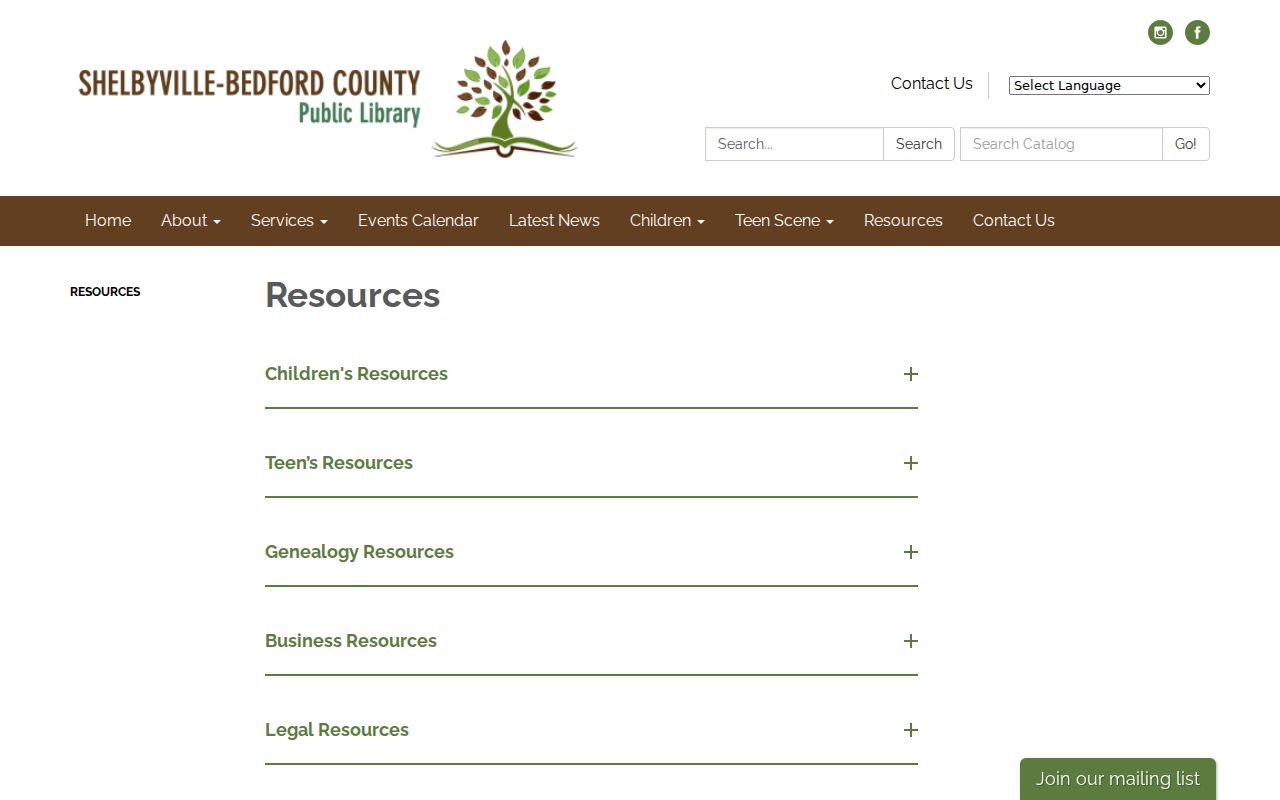
The library page identifies useful research channels but does not publish a house-history service or shelf-by-shelf inventory. Contact staff before assuming that a particular year or reverse lookup is on site.
Shelbyville Census Address Pairing
Pair a directory year with the nearest public census date, then compare address wording, surname spellings, household composition, and enumeration geography. The federal 72-year release rule made 1950 the newest public schedule at the research date. TSLA also lists Bedford publications for 1820, 1850, and an 1880 transcription. A census is an interval snapshot, not a year-by-year address list.
- Place the directory, telephone, or newspaper clue on a date line and save its repository and page reference.
- Compare it with 1920, 1930, 1940, or 1950 where applicable, or use the listed Bedford publications for earlier periods.
- Check a map, parcel description, or plat when the street name, number, rural route, ward, or district differs.
- Use an obituary, probate file, cemetery entry, or later deed only for the relationship or date actually documented.
Timing matters. Census enumeration, temporary absence, seasonal movement, and older rural descriptions can produce a reasonable mismatch without proving a person did not live in Shelbyville.
Shelbyville Address Map Evidence
The 1878 Bedford County map has a Shelbyville inset and business index. The Library of Congress also catalogs a five-sheet 1891 Sanborn map. These sources can show streets, footprints, construction material, business context, or building use. They are physical evidence, not an occupant list. Record the sheet and map date, then compare it with a deed legal description or plat before drawing an address conclusion.
Permits give a later dating layer. County Building & Codes reports enforcement beginning in 2007, while city and county files can document a project address, applicant or owner, permit type, inspection, and final stage. No public address-searchable permit index was found. A Tennessee Public Records Act request should identify the address, permit number if known, date range, project type, and request for final-inspection or occupancy material.
Shelbyville Previous Residents Trail Endpoints
Obituaries, probate, and cemetery sources can close a former-resident trail without proving a last address. A probate file may identify heirs, fiduciaries, property descriptions, and later deeds, though sensitive portions can be restricted. The Shelbyville Times-Gazette catalog and library route can lead to notices and estate references. Preserve the issue date and page when a notice is used.
Willow Mount's interment route and TSLA's funeral, burial, obituary, and cemetery leads can supply a burial date, location, family connection, or funeral-home clue. The city describes Willow Mount as a mid-1840s cemetery with more than 30,000 interments. A burial record needs a separate deed, directory, census, or probate connection before it is used as address evidence.
Lawful use. Shelbyville house-history research is appropriate for family history, estate questions, and personal curiosity. Do not use older address clues to contact, stalk, harass, or endanger a living person.